Falcon 9 launch of Italy’s COSMO-SkyMed mission scheduled for Friday evening

VANDENBERG SPACE FORCE BASE, Calif. (KEYT) – A Falcon 9 launch of the Italian Space Agency's COSMO-SkyMed Second Generation mission is scheduled from Vandenberg SFB on Friday evening.
The mission is currently targeting a 6:09 p.m. liftoff Friday, Jan. 2 after the launch was scrubbed twice.
A live webcast of the launch will start about 15 minutes before liftoff that you can watch here or via SpaceX's X/Twitter account.

The COSMO-SkyMed Second Generation mission is funded by the Agenzia Spaziale Italiana, the Italian Ministry of Defense, and the Italian Ministry of Education, Universities, and Scientific Research and seeks to add a new generation of dual-use (both civilian and military) satellites to the first-generation satellites already in orbit.
Saturday's payload of two satellites are destined for a sun-synchronous polar orbit, like their first-generation predecessors, and will carry synthetic aperture radar (SAR) tools operating in the X-band.
Each satellites is designed for a seven-year lifespan and will provide a 300 percent increase in operative bandwidth compared to the first-generation satellites noted the European Space Agency.

The mission's terrestrial command center is in Italy with data downlink stations in Argentina and Sweden shared the European Space Agency.

A depiction of how an SAR system works is shown in the image below courtesy of Coert Olmsted in the Scientific SAR User's Guide.

The different wavelengths used by SAR systems are shown in the model below. The X-band is on the far right of the SAR bands, outside of the visible light spectrum we see naturally.
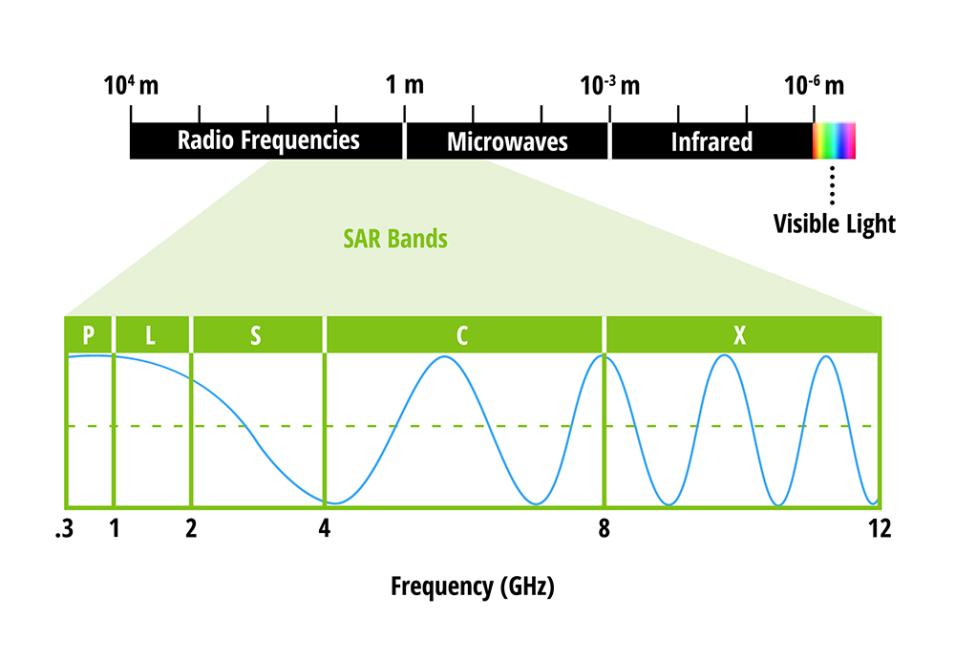
According to NASA, the X-Band is used by SAR systems seeking high-resolution imaging outside of the more commonly used C-Band.
The image below, courtesy of NASA, shows a comparison of SAR bands' penetration of tree canopies.

Data collected by the mission will be made available for free for research and development pending approval by the European Space Agency. For more information about the data set, including how to apply for access, click here.
Following first-stage separation, the booster assigned to this mission will return to Earth to land at Vandenberg SFB's Landing Zone 4.
A depiction of the launch sequence, courtesy of SpaceX, is shown in the image below.

There is the potential for one or more sonic booms across the region associated with the launch sequence, but how far the sound travels will depend on weather and other conditions at the time.
This will be the 21st mission for the assigned Falcon 9 booster which previously launched the following missions: Crew-7, CRS-29, PACE, Transporter-10, EarthCARE, NROL-186, Transporter-13, TRACERS, NROL-48, and 11 prior Starlink launches.
