UCSB researchers discover the interplay between opposing neurons in the movement of fruit flies


SANTA BARBARA, Calif. (KEYT) – UC Santa Barbara researchers confirmed that parts of the neural network that inhibit movement in fruit flies plays a critical role in coordinating their movements.
Neuroscientists Durafshan Sakeena Syed, Primoz Ravbar, and Julie H. Simpson with the Neuroscience Research Institute and UC Santa Barbara's Department of Molecular, Cellular and Developmental Biology published their findings earlier this year in the non-profit research journal eLife.
The tiny organisms have been used for genetic research for over a century because they are easy to care for, have a short lifecycle of 12 days, and, most importantly, share about 60 percent of the genes involved in human genetic diseases and some cancers.
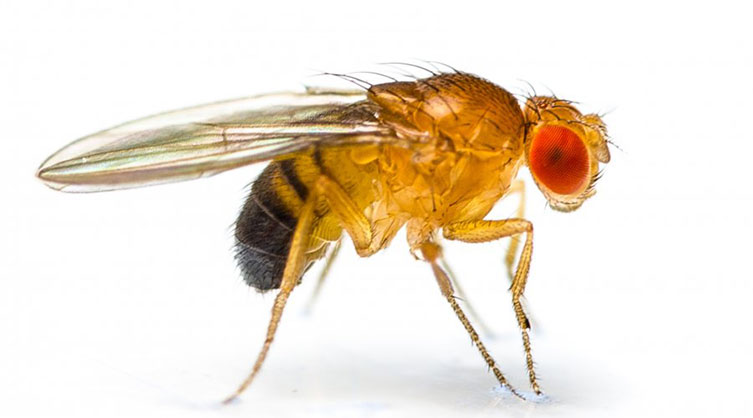
That full diagram of how messages are transmitted in the minds of fruit flies, also known as the fruit flies' connectome, has paved the way for expanding neurological research ever since.

"All animals with limbs face the challenge of coordinating their movements to achieve precise motor control. Despite a limited set of muscles in each limb, the nervous system produces multiple flexible actions to generate behavior," opened the researcher's paper Inhibitory circuits control leg movements during Drosphila grooming published in January. "We investigate the role of inhibitory neurons in coordinating which leg muscles in adult Drosophila [the genus of fruit flies] work together or antagonistically, and how they might produce rhythmic alternations."

One common movement used by fruit flies is related to grooming.
Flies swipe debris off their faces and bodies and UC Santa Barbara researchers triggered these grooming reactions by using light among other stimuli.
What the researchers found is that the simple understanding of a stimulus, like dust on their eyes, leading to motor neurons firing a message to limbs to wipe away dust, included inhibitory neurons associated with doing the opposite, stopping movement.
"The thing is, when you think about movement, traditionally you assume that the activated pre-motor neuron would excite the motor neuron [causing limbs to move]," explained Durafshan Syed. "What they [inhibitory neurons] do is put the brakes on one muscle and then the same neuron can remove the brakes from the antagonistic muscle. Since these neuron groups are reciprocally connected, they can induce the alternation between extension and flexion so you can have these repetitive movements."
Researchers found that the neural pathway to clear something from a fruit flies' eyes included motor neurons as well as inhibitory ones that worked in conjunction to activate and stop limb movements.
The images below show the interplay of motor neurons with inhibiting ones creating the precise movements triggered by researchers.


"We demonstrate that normal activity of these inhibitory neurons is essential for the rhythmic coordination of leg flexion and extension during grooming," noted the UC Santa Barbara researchers in the study."[A]ctivation or silencing of inhibitory neurons interferes with the alternation of flexion and extension required for dust removal and reduces grooming."
The inhibiting neurons also came in two distinct types: a "specialist" type that could control individual joints and finer movements and a "generalist" type that controlled multiple movements across different joints simultaneously detailed the researchers.
"During leg rubbing, proximal and medial joints within a given leg move predominantly in sync, as indicated by a minimal lag in their angular velocities," noted the research paper. "This coordination shows the presence of muscle synergies, and generalist premotor interneuron connectivity could be how these synergies are implemented."
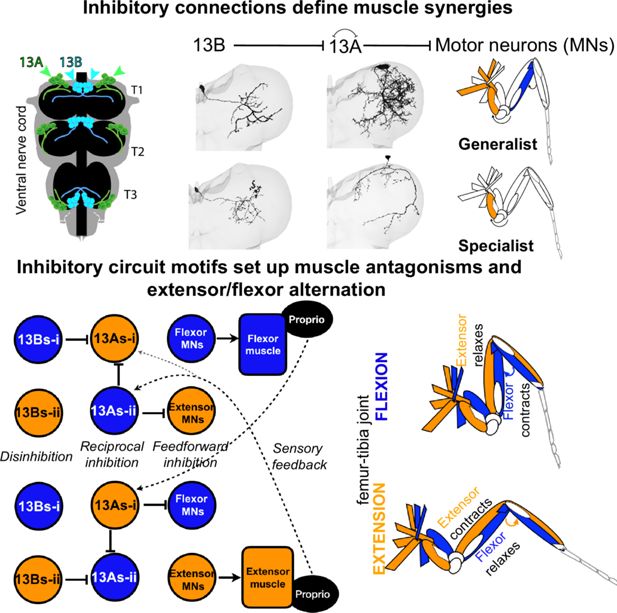
"Our experiments demonstrated that silencing or activating 13B neurons reduced grooming. Connectome data revealed that 13B neurons disinhibit groups of motor neurons. Most 13B neurons appear to act indirectly in the connectome—by contacting inhibitory neurons, potentially producing a net excitatory effect—while a subset makes direct contacts onto motor neurons," added the researchers. "Together, 13A and 13B neurons contribute to both spatial and temporal coordination during grooming."
These advances in neural network mapping took years of painstaking work by researchers at the graduate and undergraduate level shared Syed.
"The undergraduates who worked on this dataset have made important contributions in editing those neurons that laid the foundations for these discoveries."

Despite pushing the boundaries of neuroscience, Syed isn't done with the interplay amongst motor and inhibiting neurons demonstrated by the research.
"We know that flies don't stop doing what they are doing and then start a new action; it's continuous," she noted. "How does that transition happen? That's what I'm interested in."
"Our work lays groundwork for future exploration of the functional contributions of inhibitory circuits to motor control," concluded the study. "While our experiments with multiple genetic lines labeling 13 A/B neurons consistently implicate these cells in leg coordination, ectopic expression in some lines raises the possibility that other neurons may also contribute to these phenotypes. In addition, other excitatory and inhibitory neural circuits, not yet identified, may also contribute to the generation of rhythmic leg movements. Future studies should identify such neurons that regulate rhythmic timing and their interactions with inhibitory circuits."
