Trump Administration officials join Sable Offshore to celebrate forced restart of local oil production

SANTA BARBARA COUNTY, Calif. (KEYT) – Two cabinet-level members of the Trump Administration joined Jim Flores, CEO of Sable Offshore and staff while celebrating a restart of oil production at the Santa Ynez Unit.

After an aerial tour of recently restarted offshore oil infrastructure, Secretary of Energy Chris Wright and Secretary of the Interior Doug Burgum arrived via helicopter for the press conference at the local processing facility in Las Flores Canyon that was part of a forced restart of the overall Santa Ynez Unit (SYU) oil production earlier this year.
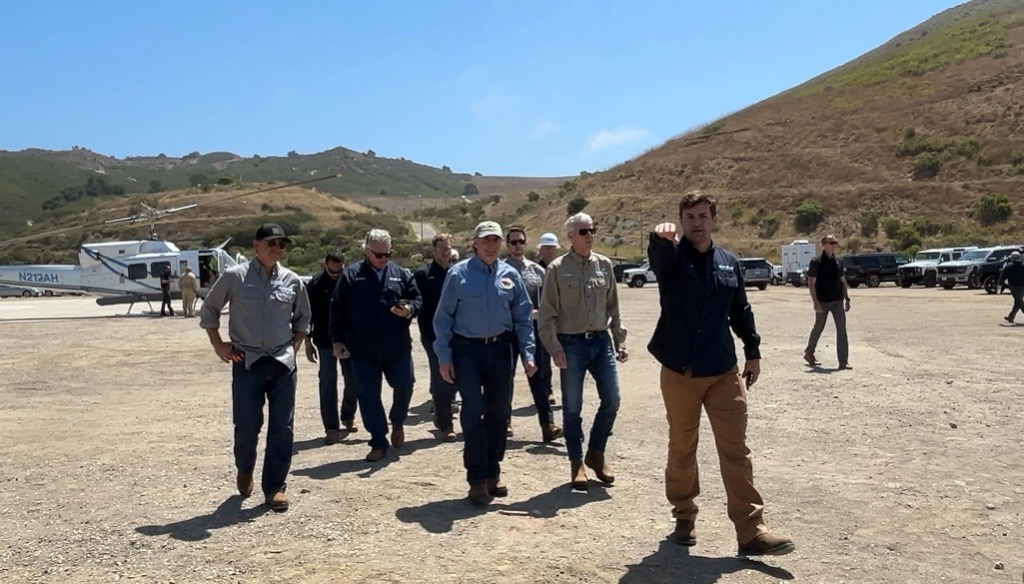
"We're the largest global exporter of oil last month in the U-S. The U-S, number one. Russia, number two. Saudi Arabia, number three," said Wright. "But yet we're standing here in a state, our largest state, our most military intensive state and two-thirds of the oil is imported from distant places overseas. Unacceptable."

(Photo Credit: Beth Farnsworth/KEYT)
"California being the poster child for having a self-inflicted energy emergency," said Burgum. "We're for a solution that gets more affordability, protects the environment and helps national security. If people are opposed to this then they would be on the side of higher prices for Californians and less national security, and more dependence on foreign oil."
Background

After the purchase of the Santa Ynez Unit, which includes onshore pipelines shuttered since a massive oil spill from a ruptured pipeline in 2015, Sable Offshore was complying with the conditions of a federal court order which required the Houston-based energy company to cooperate with state agencies for a restart of the pipelines up until late last year.
The corroded onshore pipeline, formerly known as Line 901 and now referred to as Line CA-324, spilled over 100,000 gallons of oil across 150 miles of California coastline, destroying thousands of acres of shoreline habitats.

In September of last year, Sable Offshore submitted a Request for Approval of Restart Plans to the California Office of State Fire Marshal in accordance with the consent decree agreed to by the previous operator of the onshore pipelines.
The state safety regulator found that there were still outstanding steps required before approving restart the following month.
Instead of conducting the requested safety actions, Sable Offshore instead informed investors in December of last year that it had determined that pipelines connecting the onshore oil processing plant on the Gaviota Coast to Pentland Station in Kern County are technically interstate pipelines under the Pipeline Safety Act and requested that federal regulators take over its restart plans.
Despite the court order and location of the pipelines, the Department of Transportation agreed with Sable Offshore's assessment and promptly asserted its authority over restart plans in mid-December.
During the battle over plans to restart the shuttered onshore pipelines, Sable Offshore shared with investors in an 8K filing with the U.S. Securities and Exchange Commission that it had not made additional capitol investments into onshore facilities and pipelines, but the company did make investments into an alternative plan to move crude oil from offshore platforms in federal waters using transport vessels.

During Friday's press conference, officials noted that the alternative plan to ship crude oil directly from federal waters was still a viable alternative going forward.
The alternative method would likely remove it from the jurisdiction of state-based regulators.
Forced Restart
On March 13, 2026, the Trump Administration ordered the private energy company to restart oil production despite the unmet conditions of the federal court order.
"The Trump Administration remains committed to putting all Americans and their energy security first," stated Secretary Wright at the time of the forced restart in March. "Unfortunately, some state leaders have not adhered to those same principles, with potentially disastrous consequences not just for their residents, but also our national security. Today's order will strengthen America’s oil supply and restore a pipeline system vital to our national security and defense, ensuring that West Coast military installations have the reliable energy critical to military readiness."
Notably, the Trump Administration's order to restart did not explicitly direct crude oil from the Santa Ynez Unit for exclusive military use nor limit its destination to the nation's strategic petroleum reserve and even if it had, those national security claims do not hold up to scrutiny Your News Channel found.
While the agreement in federal court required state regulators to manage restart plans at the Santa Ynez Unit, Secretary of Energy Chris Wright argued that the federal government forced the restart of oil production under the authority of the Defense Production Act of 1950 and the authority to do so was delegated to the Energy Secretary by Executive Order 13603 "National Defense Resources Preparedness" -skirting federal, state, and local regulatory authority- for national security purposes.
Federal Domestic Energy Policy
Sable Offshore shared with investors that it had resumed production of hydrocarbons from Platform Harmony the day after the announcement of a forced restart and would ramp up to full production from platforms Harmony and Heritage by the end of the same month.

The shallower Platform Hondo is expected to join its sister platforms at full production by this summer shared Sable Offshore earlier this year.
"The pipeline operator [Sable Offshore] then relied on the [U.S. Secretary of Energy] Wright Order, and a contemporaneous opinion from the U.S. Department of Justice's Office of Legal Counsel, to argue that any state laws or existing court orders standing in the way of restart could be ignored and set aside," detailed one of multiple lawsuits filed by California's Attorney General in response to the forced restart. "The very next day, on March 14, 2026, the pipeline operator restarted pumping oil through pipelines despite an outstanding preliminary injunction in state court, despite not having necessary permits from either the state or the federal government for pipeline operation, despite still not having approval from several state agencies, and despite not having a current or valid easement to keep or utilize the segment of its pipeline crossing California state property."
Sable Offshore detailed in march that Platform Harmony is producing about about 22,000 gross barrels of oil per day and the energy company expected that Platform Heritage would generate a total rate of over 30,000 gross barrels of oil per day.
Platform Hondo is expected to resume production by the end of the second quarter of this year, producing over 10,000 barrels of oil per day added Sable Offshore back in March.
Approximately 20 million barrels of oil transited the Strait of Hormuz each day before the Trump Administration conducted military strikes in Iran in late February resulting in an ongoing closure of the crucial waterway.
"We're the largest global exporter of oil last month in the US," Energy Secretary Chris Wright shared during Friday's press conference. "US number one. Russia number two. Saudi Arabia number three. But yet we're standing here in a state, our largest state, our most military intensive state and two-thirds of the oil is imported from distant places overseas. Unacceptable."
Broad statements about a domestic energy crisis do not match the same Administration's recent actions including cutting billions in energy investments, potentially outside of its legal authority, rescinding over 3.5 million acres of offshore waters leased for energy generation and cutting deals to terminate offshore wind leases for projects on both coasts, and even spending almost a billion dollars to halt plans to build offshore wind farms, an action that is now subject to a Congressional inquiry and multiple Freedom of Information Act requests by Your News Channel.
These unilateral exemptions to federal laws on behalf of private oil and natural gas companies and explicit prohibition of alternative sources of energy all under the umbrella of national security are both not new and ongoing.
"Oil trades at a worldwide price," explained a press release from California's Governor on the day of the announced restart. "American crude sells to the highest bidder, not at a discount for American consumers. Prices are surging because Trump's military strikes on Iran have disrupted shipping through the Strait of Hormuz, trapping an estimated 20% of the global oil supply in the Persian Gulf."
"Donald Trump started a war, admitted it would spike gas prices nationwide, and told Americans it was a small price to pay. Now he's using this crisis of his own making to attempt what he’s wanted to do for years: open California's coast for his oil industry friends so they can poison our beaches," added Governor Newsom. "His answer is a pipeline that would contribute just 0.05% to total global crude oil production, and that represents less than 0.3% of the petroleum products that are trapped in the Persian Gulf because of Trump's war. That is a drop in the bucket that will not solve the crisis he created."
Legal Fallout
Those disputes over the process forcing a restart resulted in the Trump Administration filing to have the Justice Department step in to defend Sable Offshore in one of multiple ongoing federal court cases connected to the restart process at the Santa Ynez Unit.
In addition to legal claims in federal court from California and environmental groups, a Congressional inquiry was launched late last month alleging financial ties between Sable Offshore's leadership and President Trump's campaigns.
"Executives at Sable have directly contributed to President Trump's campaigns...contributed over $300,000 to Super PACs like Right to Rise USA and Senate Leadership Fund which made contributions to President Trump’s 2016 and 2024 campaigns. Additionally, Gregory Patrinely, Executive Vice President and CFO of Sable, contributed thousands of dollars to Trump-aligned committees in 2020 and 2024," stated a letter from members of Congress to Sable Offshore's CEO. "During his campaign, President Trump promised to reverse environmental rules for your industry in exchange for $1 billion in donations. It is difficult to avoid the inference that actions like the use of DPA [Defense Production Act] to overcome state laws on behalf of an oil producer represents a fulfillment of that 'pay to play' promise."
Congressional members then requested that all records and communications between Sable Offshore and the Trump Administration and his presidential campaigns from January 1, 2024, going forward be preserved including the cessation of any auto-delete measures being used.
Those requested materials are expected by members of Congress later this month.
Your News Channel asked Secretary Burgum above the pending litigation and oversight requests Friday and the Interior Secretary declined to comment.
