Trump Administration relaxes environmental regulations for commercial space industry

WASHINGTON D.C. – On Wednesday, the Trump Administration issued a new executive order making changes to the licensing and permitting process for the commercial space industry including the relaxation of federal environmental reviews and changes to the Office of Space Commerce.
The executive order entitled "Enabling Competition in the Commercial Space Industry" tasks the Secretary of Transportation to "use all available authorities to eliminate or expedite the Department of Transportation’s environmental reviews for, and other obstacles to the granting of, launch and reentry licenses and permits" in order to "streamline commercial license and permit approvals for United States-based operators".
The Federal Aviation Administration issued new regulations five years ago in compliance with an executive order announced during President Trump's first term which allowed for applications to be approved for multiple launches or reentries instead of requiring a new approval for each mission.
The changes could allow for categorical exclusions from the National Environmental Policy Act for launch and reentry vehicle licenses and permits and alter regulatory requirements for space vehicles that have a flight termination system or automated flight safety system stated the executive order.
"This is the latest deregulatory action that President Trump has authorized, building on NEPA [National Environmental Policy Act] reform, the elimination of burdensome DEI requirements, and other complicated rules that increase the cost of operating businesses that benefit Americans," read a statement from the White House on Aug. 13, 2025.
Wednesday's executive order also takes aim at state-based regulatory authority.
"The Secretary of Commerce...shall, within 180 days of the date of this order, conduct an evaluation of relevant States’ compliance under the Coastal Zone Management Act pursuant to 16 U.S.C. 1458, the effect of any lack of compliance on the development of spaceport infrastructure, and whether State approvals under that Act should be revoked. The Secretary of Defense, the Secretary of Commerce, the Secretary of Transportation, and the Administrator of NASA shall also notify the Department of Justice of any State or local limitations on spaceport development on Federal lands that may be inconsistent with Federal law."
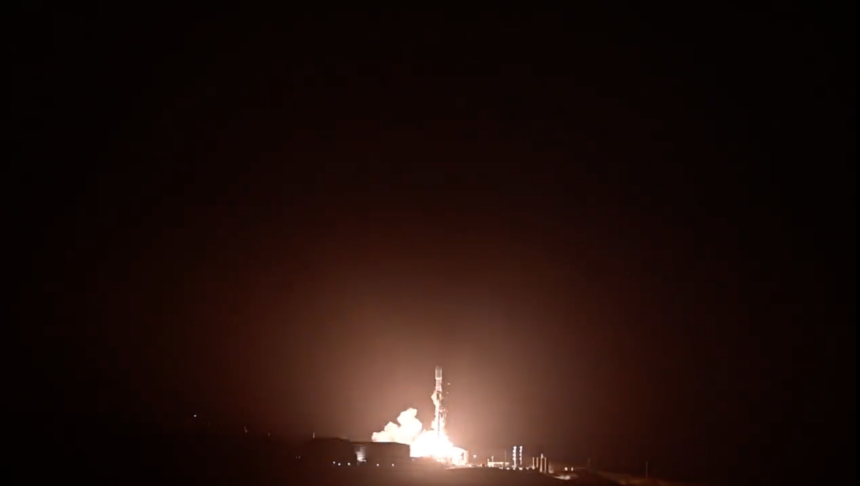
Those new evaluations come as the California Coastal Commission rejected a request to substantially increase launches from Vandenberg Space Force Base in November of last year.
The Commission's denial centered around the spaceport's federal consistency determination, a state-level determination over federal actions that impact local coastal zones, which includes the primary partner for the majority of rocket launches scheduled from the federal base, SpaceX, a private company.
Federal agencies, such as the Department of Defense, can avoid the usual permitting process through the California Coastal Commission as long as they agree to an environmental mitigation agreement, whereas private companies are subject to California Coastal Act regulations that requires permitting or permission from the Commission.
According to the California Coastal Commission back in November, "The decision to deny an increase in rocket launches at Vandenberg Space Force Base was motivated by several factors. However, the primary concern articulated by the Commissioners at Thursday's public hearing was that SpaceX, as a private company, should itself be applying for a coastal development permit under California state law."
In response, SpaceX filed a lawsuit in the U.S. District Court for the Central District of California, arguing that the Coastal Commission does not have jurisdiction over federal agency activities at the spaceport located on California's Central Coast.
"[T]he National Defense Strategy, the U.S. Defense Department Commercial Space Strategy, and the U.S. Space Force Commercial Space Integration Strategy, uniformly concluded that commercial space capabilities—including launch—are critical to the national security interests of the United States," stated the lawsuit. "[T]he Commission’s punitive decision, violating core Constitutional protections of free speech and due process, undermines U.S. national security and is blatantly illegal, trampling over (i) federal law; (ii) exclusive federal jurisdiction over military bases and other federal enclaves; and (iii) the Commission’s own governing statutory boundaries."
While SpaceX leases launch infrastructure from Vandenberg Space Force Base for the Falcon 9 launch program, the U.S. Air Force, "retains ultimate authority over the use of the land and launch facilities" noted the lawsuit.
"[T]he Commission’s decision to not concur in the Air Force’s consistency determination and demands that SpaceX submit a consistency certification and obtain a CDP [coastal development permit] should be declared unlawful under the First Amendment of the United States Constitution, unenforceable against SpaceX, and enjoined," concluded the lawsuit. "If the Commission’s activity delays or prohibits even a single SpaceX launch, such a delay or cancelation could cost SpaceX for launch delay, launch replanning, or damages for being unable to timely fulfill commitments to its customers."
This week, staff with the California Coastal Commission published a report rejecting the latest consistency determination that includes SpaceX submitted by the Department of the Air Force finding, "that DAF [the Department of the Air Force] has not provided sufficient information to enable the Commission to determine that the proposed project is consistent with the enforceable policies of the California Coastal Management Program."
"In addition to doubling the number of SpaceX launches from the current level, DAF’s CD [consistency determination] proposes to double the number of landing events, with up to 24 SpaceX rocket landing events per year at VSFB [Vandenberg Space Force Base], including up to 12 first stage boosters per year at SLC-4 and up to 12 landing events at SLC-6, including five Falcon Heavy missions where two boosters would land simultaneously," detailed the Commission's report published Wednesday. "SpaceX would also carry out up to 76 at-sea landing events of its rocket first stage boosters offshore of Baja California, Mexico, and each time would transport that first stage by ocean barge to the Port of Long Beach, transfer it to a different ocean barge and then bring it to Vandenberg Harbor where it would be offloaded onto a land transport vehicle and returned the short distance across VSFB to SpaceX’s leased launch complexes for refurbishment and reuse. The project CD also proposes up to ten SpaceX launches per year that may include expendable first stages (five Falcon Heavy center core boosters and up to five Falcon 9 launches) that would be discarded into the Pacific Ocean. These boosters are roughly two hundred feet long with a diameter of 12 feet and comprised of a mix of materials, primarily metals."
Wednesday's executive order also elevated the Office of Space Commerce into the Office of the Secretary of Transportation and required the appointment of a non-career employee to serve as the Associate Administrator for Commercial Space Transportation under the Administrator of the Federal Aviation Administration.
Additionally, a new process has been requested to be established within 150 days of the executive order to authorize individual missions that are, "not clearly or straightforwardly governed by existing regulatory frameworks, with the goal of expediting and streamlining authorizations to enable American space competitiveness and superiority."
This new process for novel missions are explicitly not related to human space flight noted the executive order.
"People think the Department of Transportation (DOT) is just planes, trains, and automobiles – but we have a critical role to play in unlocking the final frontier," said U.S. Transportation Secretary and acting Administrator of the National Aeronautics Administration (NASA) Sean Duffy. "By slashing red tape tying up spaceport construction, streamlining launch licenses so they can occur at scale, and creating high-level space positions in government, we can unleash the next wave of innovation. At NASA, this means continuing to work with commercial space companies and improving our spaceports’ ability to launch...I look forward to leveraging my dual role at DOT and NASA to make this dream a reality."
