What is a digital business card and how do they work?


A digital business card is the modern replacement for the paper card you hand over at a meeting, a conference booth, or a jobsite. Instead of printing your name, title, and phone number onto a stack of cardstock, you share a link, a QR code, or a wallet pass that opens a page holding your contact information. The person you just met scans it or taps it, and your details land on their phone in seconds. There is no app to download, no card to lose, and no box to reprint every time your job title, number, or company changes. Linktree provides in-depth knowledge into digital business cards and how to modernize your virtual presence.
Most digital business cards work the same basic way. You build a profile once, with whatever you want a new contact to know: your name, role, company, phone number, email, and often links to your website or social accounts. That profile lives online, and you share it through a QR code, a near-field communication (NFC) tag, a wallet pass, or a plain link. When someone scans or taps it, they land on your profile in their phone’s browser, with no dedicated app required on their end. Many services also let the other person save your details straight to their contacts, and some let them share their own information back with you, so the introduction works both ways.
Why paper cards are losing ground
Paper cards have an obvious shelf-life problem. A phone number changes, a title changes, a company changes, and the stack in your bag is outdated the moment those details shift. Most also end up in a drawer or a bin within a week, since there’s no easy way to act on one later without typing everything in by hand. Digital versions solve both issues at once, as they update the instant you change your details, and they hand the other person something to save or tap through immediately.
That combination, always current and instantly actionable, is why digital cards have become a normal part of networking rather than a novelty:
- Always current: Update your details once, and every card you’ve shared reflects the change, with nothing to reprint.
- No printing costs and no boxes of outdated cards to toss when your details change.
- Works with just a phone camera. The other person doesn’t need to install anything.
- Many cards let visitors save your info to their phone, and some let them hand their own details back to you.
- Some services include basic analytics, so you can see roughly who opened or scanned your card.
- Easier to carry, since it lives in your phone rather than a stack in your bag or glove box.
Who actually uses them
Digital business cards get the most use from people who exchange contact details often and in person: freelancers and consultants meeting new clients, real estate agents working open houses, tradespeople quoting jobs on-site, musicians after a gig, wellness practitioners meeting new clients, and sales teams working a conference floor. Anyone with a steady stream of “here’s how to reach me” moments tends to benefit from swapping cardstock for something that lives in their pocket and updates itself.
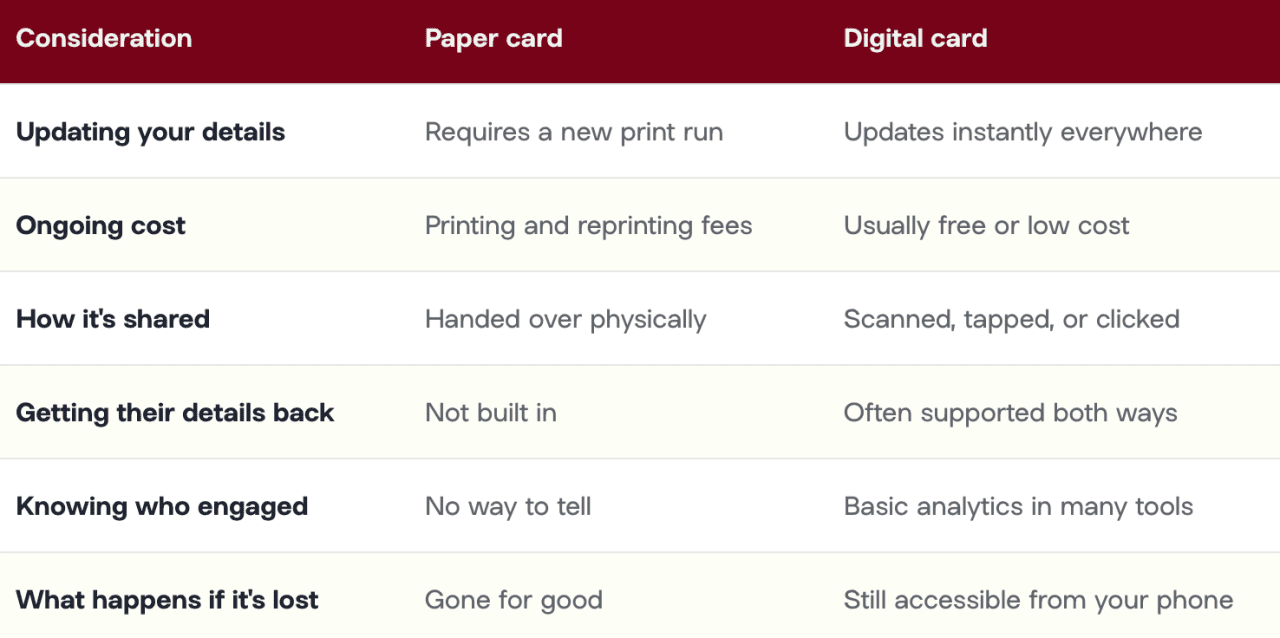
Here’s roughly how the two formats compare:
Why creators, influencers, and business professionals benefit most
For creators and influencers, a card is rarely about a phone number. A scan works better as a shortcut to everything else you’re already doing: your latest video, your merch, your booking page, and the accounts someone should actually follow. If you hand someone a static contact card, most people will forget who you are by the next event, but if you hand them something that opens to your whole presence, then they have a reason to look you up later, follow you, or book you.
For business professionals, the part that usually falls through is closing the loop after a conversation. A prospect who has to type your number in later often just doesn’t, and a card shoved into a jacket pocket has a short life span. A digital card removes both problems: Your details save in one tap, and if the card supports two-way exchange, you walk away with theirs too, ready for a proper follow-up instead of a vague memory of who you spoke to. It also means one consistent, current version of your professional details rather than a card that quietly goes stale while the rest of your online presence moves on without it.
Whether a digital business card is worth setting up comes down to how often you hand out contact details and how much of your work already lives online. If you already manage your presence through a single profile or link-in-bio page, a digital card version of it is a small extra step. If you’re starting from nothing, it’s worth deciding what you actually need: a simple way to exchange contact information or something that opens onto your wider online presence at the same time. Either way, the shift away from paper is well underway, and there’s little downside to trying a digital card before your next stack of printed ones runs out.
This story was produced by Linktree and reviewed and distributed by Stacker.
