How many people own crypto in your state? New data reveals the answer


Since crypto first dominated the headlines in 2021, owning bitcoin and other tokens has become associated with living in a handful of geographic hot spots. New York is now a hub for crypto startups, Silicon Valley is home to blockchain engineers, Texas attracted miners and Miami has transformed into the center for major crypto events.
Yet the United States has over 67 million crypto holders spread throughout its regions. New research from the 2026 State of Crypto Holders Report by the National Cryptocurrency Association found that—no surprise—California has the largest number of people owning crypto tokens, with an estimated 9.5 million people holding cryptocurrency of some kind. That’s predictably followed by Texas, Florida and New York.
Outside the four big hot spots, people own crypto across the country in proportions that more or less track to state population numbers. More than 56 million cryptocurrencies exist at the time of writing this article, according to the price data tracker CoinMarketCap.
A crypto holder can be defined as a person who owns bitcoin or any of the 53 million digital currencies available. Bitcoin is the largest crypto, with over 20 million tokens in supply, worth over $1.2 trillion as of August 2026.
Ahead, OpenSea reports on the number of crypto holders in every U.S. state, using data from the National Cryptocurrency Association.
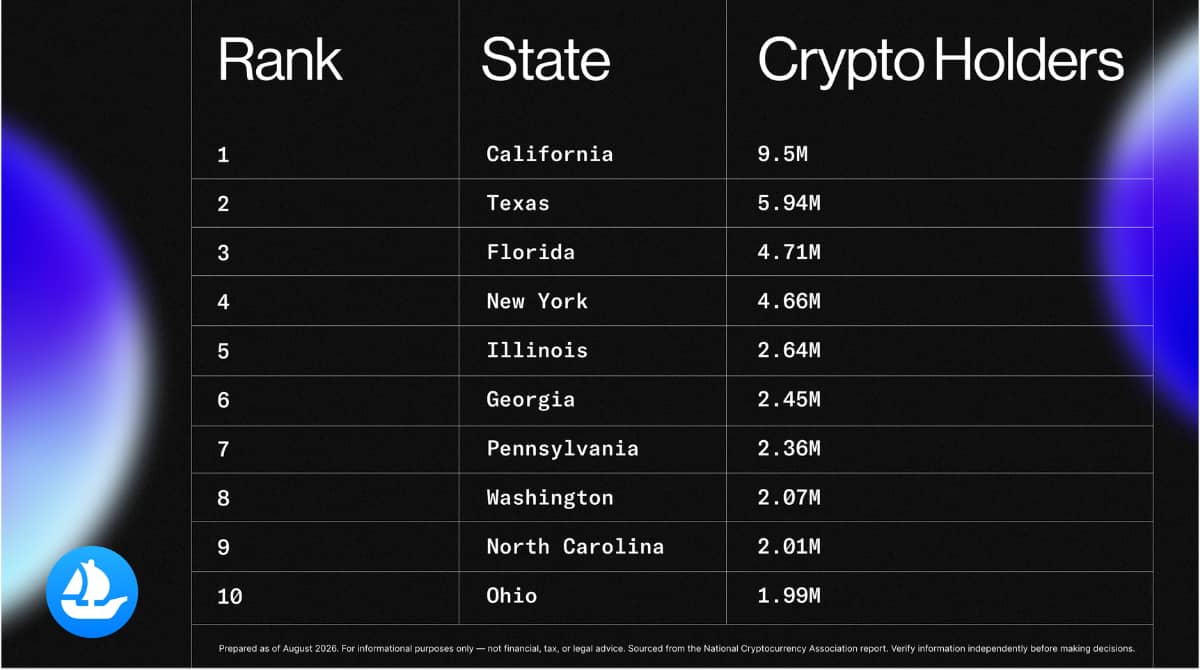
The top 10 states for crypto ownership
California leads the country with 9.5 million crypto holders, nearly double the amount reported in Texas, the next closest state. The Lone Star state follows California at 5.94 million, and then comes Florida at 4.71 million and New York at 4.66 million. That wraps the four states most people would probably assume are where most crypto holders live.
Illinois takes the No. 5 spot with 2.64 million holders, followed by Georgia at 2.45 million and Pennsylvania at 2.36 million. Washington ranks eighth with 2.07 million, North Carolina ninth with 2.01 million and Ohio rounds out the list at 1.99 million.
According to the National Cryptocurrency Association’s report, these numbers are part of a bigger national shift. Survey data found that one in four American adults now owns crypto, which is over 67 million people. That’s up from one in five just a year ago. An estimated 12 million Americans have become crypto holders since 2025, roughly equal to the combined population of New York City and Los Angeles.
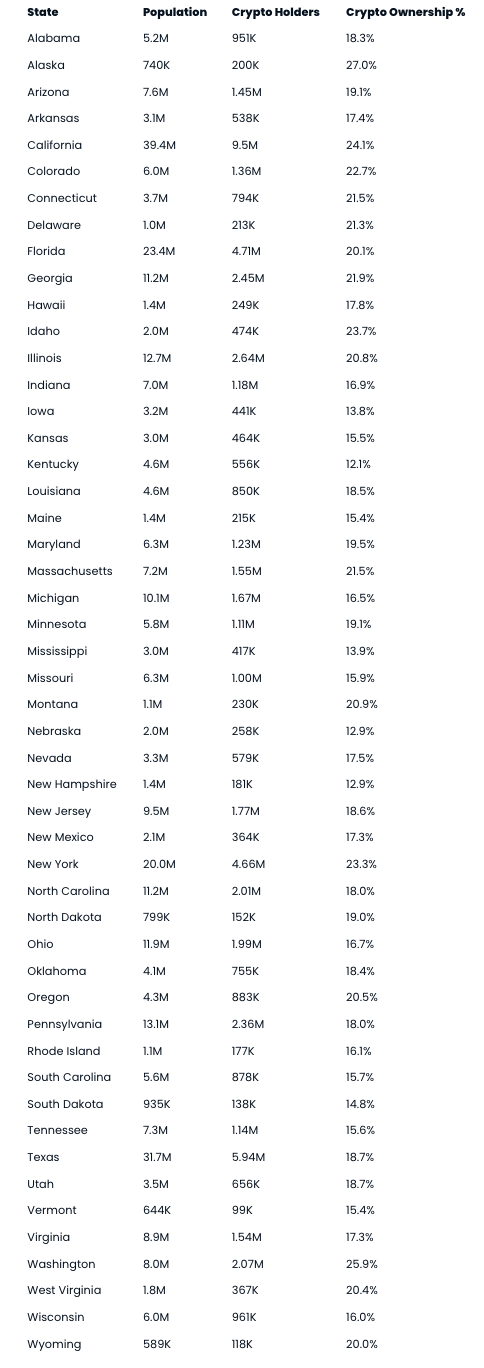
Crypto holders by state, with population comparison
Looking beyond the top states, a nationwide state-by-state comparison shows that crypto ownership is widespread across the country.
Here’s how many crypto holders live in each state compared with the state’s total population.
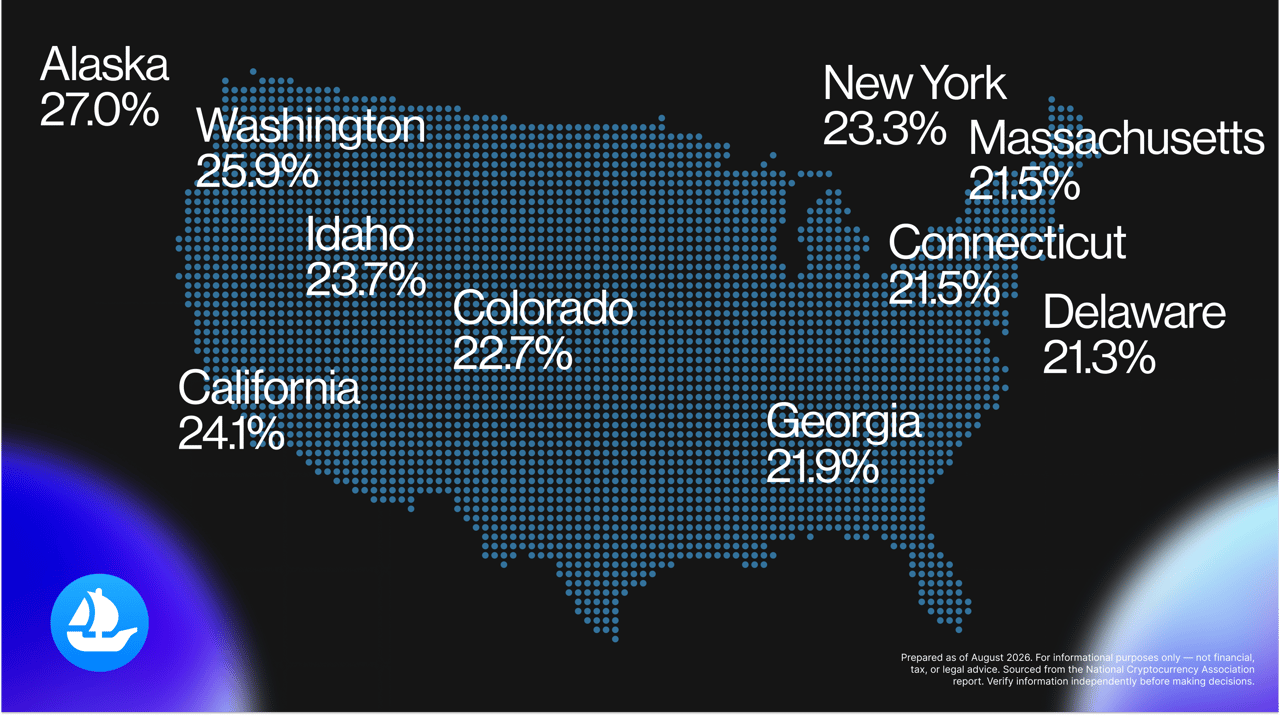
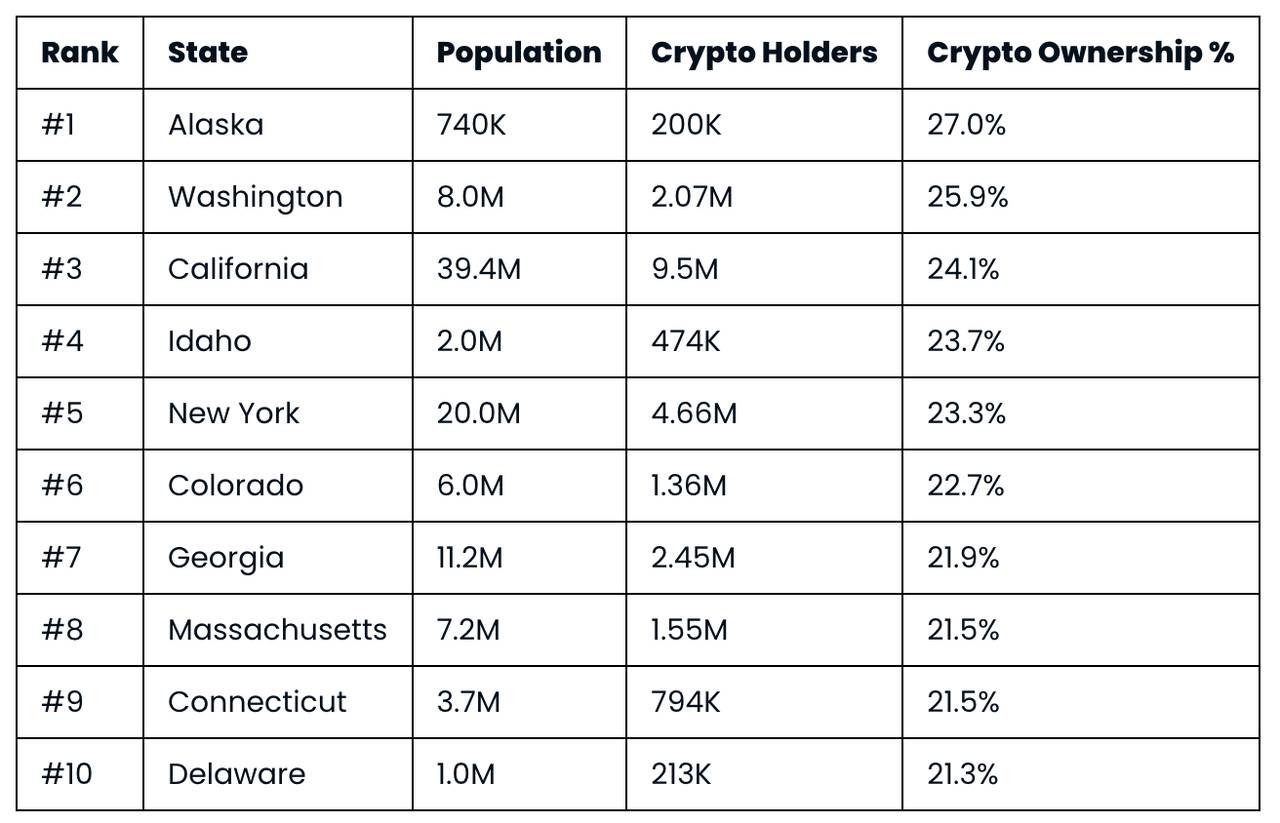
The top 10 states by percentage of people who own crypto
While California, Texas and Florida have the largest crypto communities by sheer number of holders, a few less-populated states rise to the top when measured by the percentage of residents who own cryptocurrency.
According to the data, Alaska leads the country in crypto density, with more than one-quarter of its population estimated to hold digital assets. Idaho, Colorado, Delaware and others that also didn’t make the top 10 in crypto ownership still rank high among states with the highest concentration of crypto owners.
Overall, the data suggests that crypto ownership is not only a coastal-state phenomenon; Americans across the U.S. hold crypto tokens.
Methodology
Crypto ownership estimates are based on an online survey conducted by National Cryptocurrency Association and The Harris Poll among 10,000 people in the U.S. from February 12 to March 3, 2026. The survey uses demographic weighting and Bayesian credible intervals, with an estimated precision of +/- 0.7 percentage points at a 95% confidence level. The study does not specify a minimum ownership threshold or additional criteria used to define a cryptocurrency holder.
To provide additional context, OpenSea compared estimated crypto holder counts with state population data from the U.S. Census Bureau population estimates. Crypto ownership percentages were calculated by dividing the estimated number of crypto holders in each state by the state’s total population, then multiplying by 100.
Population figures are rounded for readability, and crypto ownership percentages are intended to provide an estimate of adoption levels rather than an exact measurement of every resident who owns cryptocurrency.
Disclaimer: This content is for informational purposes only and should not be construed as financial or trading advice. Readers should independently verify any claims made herein before acting on them. Readers are solely responsible for conducting their own due diligence before making any decisions.
This story was produced by OpenSea and reviewed and distributed by Stacker.
