Monty Roberts’ legacy lives on in the Santa Ynez Valley through his family
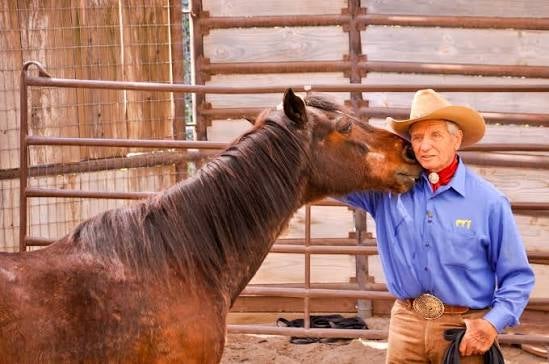

SANTA YNEZ VALLEY, Calif. - Monty Roberts believed there was a better way to communicate with horses. One built on trust rather than force.
That philosophy would take the Santa Ynez Valley horseman from the rodeo arenas of California to the royal stables of England, changing the way people around the world approached horsemanship.
Roberts died in July at the age of 91. But at his longtime home in Santa Barbara County, his family says the lessons he spent a lifetime teaching are far from over.
Roberts' journey began as a teenager, when he watched wild mustangs roaming the Nevada desert while rounding them up for a Salinas rodeo.
Rather than simply viewing the animals as something to be controlled, he began studying their movements, body language and interactions with one another.
He believed horses communicated through subtle physical cues and that understanding those signals could create a relationship built on mutual trust.
Instead of breaking a horse's spirit, Roberts developed an approach that allowed the animal to make its own choice to approach and interact with a person.
His daughter, Debbie Roberts Loucks, says that connection was central to her father's work.
"The horse trusted him, but the horse responded to it and actually wanted to give him more," she said.
One of the horses who became closely associated with Roberts was Shy Boy, a once-wild mustang who demonstrated the bond Roberts believed could exist between horses and humans.
What began as an observation in the desert eventually became his life's work.
The Roberts family has called Santa Barbara County home since the 1960s.
"Santa Barbara County has been our home since 1966. Mom and dad built this place in 65 and 66 and moved in, in 66… which is a long time," Debbie Roberts Loucks said.
But Roberts' influence would extend far beyond the valley.
In 1989, he was invited to demonstrate his training methods to Queen Elizabeth II at Windsor Castle.
The meeting helped bring international attention to his philosophy. He was later appointed an honorary member of the Royal Victorian Order.
"Meeting the Queen in 1989… It's unbelievable in some ways," his daughter said. "But it did change his life and mom's life, and all of our lives really."
Roberts' compassion was not limited to animals.
Over the years, he and his wife, Pat Roberts, opened their home to 47 foster children. He also worked with veterans living with post-traumatic stress, extending his philosophy of trust and communication to people facing their own challenges.
His daughter says her father often felt misunderstood, even within the traditional rodeo and horse-training communities.
"Dad was like he had never been affirmed… pretty much told what to do sternly," she said. "Even into the rodeo world, all of that, he was considered a little bit of the outside, did things a little."
Despite that, Roberts continued sharing what he believed horses could teach people about relationships, patience and understanding.
Now, his family is working to ensure his teachings continue reaching new generations.
They are keeping the doors open to people who want to learn his methods and better understand the connection between horses and humans.
His wife, Pat, says his legacy is reflected not only in the horses he influenced, but also in the people he reached through his work and writing.
"I think his legacy is not only the impact that he made on the world of horses, horsemanship, people, but also what he's written and what he shared," she said. "And, he was put on this earth for a good reason."
For Debbie, remembering her father means making sure people don't see his passing as the end of what he started.
"The way I want people to remember dad is just exactly how they think of him right now. I actually don't want him… I don't want people necessarily to think that he's past," she said.
"And that sounds kind of odd, but it almost sounds like an end of an era, like he's a guru. And when a guru passes, it sort of passes on with them and can go away."
Before his passing, NewsChannel spoke with Roberts in 2024. He shared a message he hoped people would carry with them, one that went well beyond horsemanship.
"Everybody could learn what I've learned. Just open your mind, think about it, and take violence away from relationships in your life," Roberts said.
Before his death, Roberts completed writing his book, What the Horses Said, which is now available for pre-order and is scheduled for release in January 2027.
For his family, the book is another way to ensure his teachings continue to reach people long after his passing.
And for those who knew him, his legacy remains rooted in a simple belief: sometimes, the strongest connection comes not from control, but from listening.
