Does your body absorb heavy metals? Bioavailability explained


If you believe TikTok, everything in your pantry is trying to poison you. One week, it’s Girl Scout cookies or protein powders laced with lead. The next, it’s farm-fresh veggies riddled with arsenic. The implication: If it’s in your food, it’s in your body, and that’s bad news.
But it’s not that simple, or that scary. Many foods contain trace amounts of heavy metals because these elements occur naturally in soil and water and can make their way through the food chain into produce and meat. But your gastrointestinal tract isn’t a pipeline straight to your bloodstream. It’s a selective filter that blocks, binds, and eliminates heavy metals to reduce the amount entering your bloodstream and the risk of harm to your health. Only a fraction of the heavy metals you eat are absorbed; most pass right through your system.
This concept — that not everything you eat is absorbed — is called bioavailability, and this LMNT article demystifies it to help you separate real toxicology from fearmongering.
Does Your Body Absorb All the Heavy Metals You Eat?
No, your body only absorbs a small fraction of the heavy metals you consume. This fraction, known as a food’s bioavailability, depends on a long list of factors, including what else you eat, your nutrient status, gut health, age, and more.
Keep in mind, many essential minerals you actually need for life, like iron, zinc, and copper, are heavy metals in the chemical sense.
The ones worth worrying about are the nonessential metals, like lead, cadmium, mercury, and arsenic. These serve no useful purpose in the body, and, at high enough levels, they can cause harm. But here’s the part that usually gets lost in translation: dose and absorption matter. Most vitamins, minerals, and metals can be toxic at certain levels; it’s the exposure and bioavailability that make the difference.
Trace amounts of nonessential heavy metals show up naturally in food, but your body only absorbs a small fraction of them. Here’s what the research suggests about approximately how much is absorbed in adults in typical dietary situations:
Some of those percentages might look alarming, but keep this in mind: These are percentages of an already small amount. Research shows that the heavy metal content in a serving of many whole and packaged foods falls well under federal and international safety limits.
To put it in perspective, let’s look at the amount of lead in a serving of four common foods, along with how much your body actually absorbs, based on a 3%-10% absorption rate.
As you review this table, keep in mind that the Food and Drug Administration recommends total daily lead intake from food stays under 8.8 mcg for women of childbearing age — its most protective limit — and under 12.5 mcg for the general adult population.
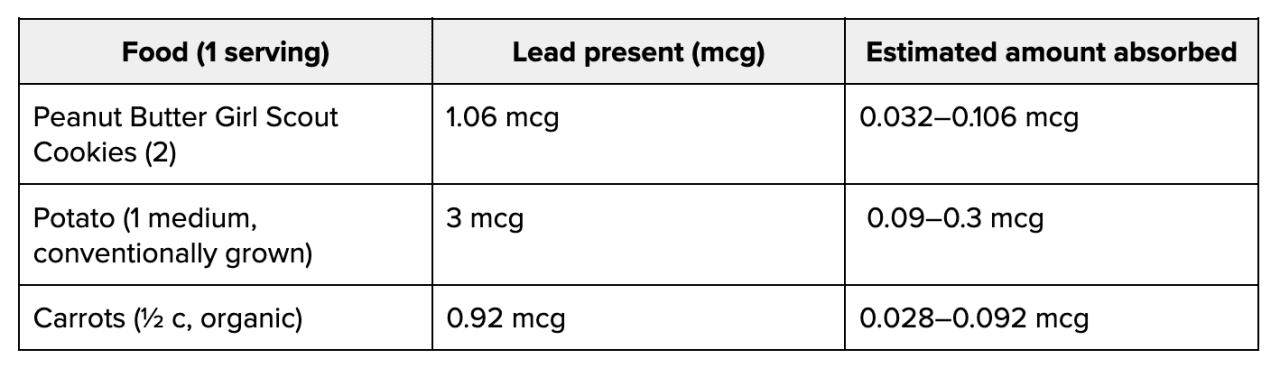
Even at the high end, these absorbed quantities are so microscopic they’re not even visible to the human eye. A single grain of salt weighs about 60 mcg — that’s about 566 times heavier than the amount of lead absorbed from any of the foods above.
What’s more, a portion of the small amount your body absorbs is processed and excreted through stool and urine. For example, most of the arsenic your body absorbs is converted into a less harmful form by the liver, and 70%-80% is cleared out within a week.
How Food Protects You From Heavy Metal Absorption
Your body doesn’t passively soak up whatever you eat. Many whole foods contain nutrients and compounds that bind, block, or escort heavy metals out of your system.
Selenium: Counteracts mercury
Selenium is a mineral that binds strongly to mercury. When these two nutrients are ingested together, less toxic mercury-selenium complexes are formed, which are harder to absorb and easier to eliminate.
Selenium may also play a role in demethylation, the process that converts methylmercury (the more absorbable form) into inorganic mercury, which is largely excreted. This is an active area of research, with much of the evidence so far coming from experimental studies.
And it supports a healthy gut barrier, which prevents metals from “leaking” into circulation.
While fish is often flagged for containing high levels of mercury, headlines don’t mention that many species also contain selenium. When selenium levels exceed mercury levels (the case in nearly all commonly eaten fish), selenium may help reduce mercury toxicity by forming stable complexes.
Bottom line: For most people, eating two to three 4-ounce servings of salmon, sardines, or trout each week keeps mercury exposure within safe limits while providing omega-3 fats, protein, and other essential vitamins and minerals.
Calcium, iron, and zinc: Block heavy metal absorption
Heavy metals and essential minerals compete for the same nutrient transport proteins in your gut. When you eat nutrient-dense meals, more minerals occupy these transporters, leaving fewer available for heavy metals, effectively blocking their absorption.
- Zinc decreases cadmium absorption.
- Iron decreases both lead and cadmium absorption.
- Calcium decreases lead absorption.
Fiber and phytochemicals: Bind and block heavy metals
Compounds in plant foods, including dietary fiber, polyphenols, and other phytochemical compounds, reduce the absorption of heavy metals. This may be because they bind to heavy metals in the gut, forming complexes that are too large to cross the intestinal wall and are unable to use metal transporters.
The result: Heavy metals like mercury, cadmium, lead, and arsenic are excreted instead of absorbed. Phytochemical compounds with heavy metal-reducing properties include:
- Catechins in green tea
- Quercetin in apples and onions
- Proanthocyanidins in berries
- Carotenoids in carrots and spinach
- Curcumin in turmeric
Fiber and phytochemicals also support a diverse, resilient gut microbiome and strengthen the intestinal barrier, both of which may further reduce heavy metal absorption.
Probiotics: Support a healthy gut barrier
Research suggests that consuming certain probiotic strains (via yogurt or supplements) may reduce blood levels of heavy metals in people with known exposure. The likely reason: reduced absorption in the gut.
Here’s what might be causing that:
- Probiotic bacteria, including Lactobacillus strains, may improve gut barrier integrity. In one animal study, Lactobacillus plantarum helped block cadmium absorption by reversing damage to tight junction proteins — structures in the gut’s lining that prevent compounds from “leaking” into circulation.
- Probiotic bacteria may also help trap and eliminate heavy metals or convert them to less bioavailable forms the body can’t absorb as well, according to lab studies.
Although early findings are promising, much of this evidence comes from animal and lab studies, with only limited human research so far — more is needed to confirm these effects.
The bottom line here: Foods often flagged for containing heavy metals also contain nutrients that prevent their absorption. Testing reports measure total content but don’t reflect these protective interactions, missing the complete biological picture.
Why Do Some People Absorb More Heavy Metals Than Others?
Two people can eat the same meal and absorb very different amounts of heavy metals. That variability comes down to individual factors like nutrient status, life stage, and gut health.
Nutrient deficiencies
Low mineral status opens the door to higher metal absorption. Iron, zinc, and calcium deficiencies are linked to higher absorption of heavy metals like lead and cadmium. Animal studies have found that mice on a calcium-deficient diet eliminated 40% less lead than mice that got enough calcium.
Here’s why: When you’re low on these nutrients, it makes it easier for heavy metals to attach to the nutrient transporters in the gut and enter your circulation. Mineral deficiencies often trigger the body to create more of these transporters, giving heavy metals more “doors” to slip through and less competition to get through them.
Life stage
Children can absorb 40%-50% of the lead they ingest. That’s about four to five times as much as adults, and they’re more likely to be on the high end if they have iron and calcium deficiencies.
Although research is lacking, pregnant women may also absorb more heavy metals. That’s because, as nutrient demands rise, many pregnant women experience nutrient deficiencies that can increase heavy metal absorption.
Research in rats suggests that pregnancy may also increase the number of nutrient transporters, which can let more heavy metals into the body.
Gut microbiome and barrier function
Your intestinal lining is meant to be selectively permeable, allowing the regulated uptake of vitamins, minerals, and other nutrients into circulation while keeping harmful compounds out, or at least reducing their absorption.
Alcohol, low fiber intake, and high sugar consumption disrupt the balance of microbes, leading to changes that make the gut barrier “leaky,” or less discerning about what (or how much) gets through. When that happens, heavy metals may have an easier route into circulation.
Gut microbiome disruption can also blunt demethylation of a highly toxic form of mercury, a reaction that makes mercury less bioavailable and less toxic.
What Bioavailability Means for Your Daily Food Choices
Most foods contain trace heavy metals, but most healthy adult bodies are generally well-equipped to handle those minuscule exposures, especially when you’re properly nourished. So it’s best not to fixate on whether a specific food contains metals.
Instead, ask: “Am I eating in a way that minimizes their bioavailability?” Here’s what that looks like in practice:
- Focus on overall diet quality, not trace-level contamination. Build meals around whole and minimally processed vegetables, fruits, nuts, seeds, legumes, healthy fats like olive oil, and high-quality dairy, fish, and meats. These foods supply the minerals that block metal absorption and the fiber that helps remove what gets through.
- Meet your mineral needs. Regularly eat foods rich in calcium (e.g., dairy, sardines and salmon with bones, dark greens), iron (e.g., beef, beans, lentils, spinach), zinc (e.g., fish, meat, pumpkin seeds), and selenium (e.g., Brazil nuts, sardines, cottage cheese, eggs). Getting enough of these minerals ensures that transport proteins in the gut move nutrients into circulation instead of heavy metals.
- Maintain a healthy gut. A healthy microbiome supports detoxification and gut barrier integrity. Prioritize fiber, probiotic-rich fermented foods, and colorful plant foods containing phytochemicals. Limit alcohol and sugar and take steps to curb stress.
Trace heavy metals are everywhere, but your body has systems in place to deal with them. So don’t major in the minors. Stay nourished, keep your gut healthy, and you’ll have already solved most of the problem.
FAQs
Does your body absorb all the heavy metals you eat?
No. Bioavailability varies widely depending on the metal, your nutrient status, gut health, and the overall food matrix (the physical and chemical structure of a food). A significant portion of heavy metals passes through the digestive tract unabsorbed, while another portion is processed by organs like the liver and eliminated.
How does selenium protect against mercury?
Selenium (especially when present in greater quantities) binds tightly to mercury, forming stable, less toxic complexes that reduce its reactivity and absorption. Selenium also supports demethylation, a process that converts methylmercury into less bioavailable inorganic mercury. Most fish contain more selenium than mercury, providing natural protection.
Why do some people absorb more heavy metals than others?
Absorption depends on factors like nutrient status, gut integrity, and life stage. Deficiencies in minerals such as calcium, iron, and zinc increase metal uptake because these elements share nutrient transport pathways. In fact, pregnant women may absorb more lead as they’re at greater risk for iron deficiency, while growing children may absorb more due to greater nutrient demands.
Are heavy metals in vegetables dangerous if they’re not absorbed?
No. Only a portion of the trace metals present in vegetables is absorbed, and many plant components may reduce absorption further. Fiber, polyphenols, and minerals in vegetables bind metals in the gut and support elimination. The nutrients that make vegetables healthy are the same ones that help keep heavy metals in check.
This story was produced by LMNT and reviewed and distributed by Stacker.
