Recent Ice Growth in Eastern Antarctica Only Temporary As Ice Mass Observations Continue to Fall Globally Researchers Find


SANTA BARBARA, Calif. (KEYT) – Researchers believe they have figured out what caused a brief increase in ice mass growth in East Antartica that offset losses on the Western side of the land mass, but that yearslong offset won't limit global, decadeslong ice loss, a major contributor to sea level rise.
The joint research team from UC Santa Barbara and the University of Washington and a globe-spanning team of other academics and reasearchers published their report, Multiyear tropical warm pool warming drives slowdown in Antarctic mass loss, in Nature Wednesday.

"Our study identifies the mechanisms responsible for this recent slowdown in melting and shows that it could be temporary," explained the report's lead author UC Santa Barbara Professor Qinghua Ding. "The climate system is complex...Every year brings new surprises and we have to stay curious, humble and open minded to improve our theories."
Scientists have tracked ice mass changes across the globe and found that for decades there has been a sustained loss in ice mass, especially in places outside of the polar regions.

According to observations made by NASA's Gravity Recovery and Climate Experiment (GRACE) satellites, between 2002 and 2025, Antarctica alone lost around 135 gigatons of ice each year, resulting in a sea level rise of 0.4 millimeters per year.
That sea level rise doesn't sound like much, but over decades it really adds up notably because of where humans live.
A substantial share of the human population lives in close proximity to coastlines including 129 million Americans and almost 30 million Californians detailed the National Oceanic and Atmospheric Administration (NOAA).
"Future global sea-level rise is contingent on the stability of the Antarctic Ice Sheet, which remains the largest source of uncertainty in long-term sea-level projections," noted Wednesday's report.
The image below shows where the sharpest changes in ice mass occurred with a notable reduction in the Western edge of Antartica.

Despite those long-term trends, there was a sharp increase in surface ice mass in Eastern Antartica between 2021 and 2023.
While previous long-term precipitation models predicted poleward-shifts in storm paths and increased moisture in Antartica, the exact mechanism that caused the recent growth has been identified.
"Over the past three decades, the AIS [Antarctic Ice Sheet] has shown pronounced regional contrasts in mass changes," explained the report in Nature. "Coastal precipitation around East Antarctica is primarily regulated by large-scale atmospheric circulation variability, with episodic, high-intensity synoptic storms and atmospheric rivers...During 2021–2023, EA [Eastern Antarctica] experienced a large mass gain, leading to a slowdown in integrated Antarctic-wide mass loss over the past two decades, despite continuing mass loss in West Antarctica. Previous studies have linked the EA mass-gain event to several factors, including enhanced precipitation associated with clustered AR [atmospheric rivers] intrusions, the prolonged triple-dip La Niña that displaced Southern Hemisphere storm tracks poleward, cyclonic circulation anomalies and reduced sea ice extent."
The hope was that the increase could slowdown the decadeslong global march towards ice mass reductions and increasing sea levels, but that may have been wishful thinking.
"In the early 2020s, there was an exceptional amount of snowfall over parts of Antarctica," Professor Eric Steig of the University of Washington and co-author of the report shared. "Because Antarctica is so big, it doesn't take that much extra snow thickness to counter the loss of ice from the edges of the ice sheet, which led to the perception that the loss of ice is slowing down."
Those observations inspired researchers at UC Santa Barbara and the University of Washington to figure out what exactly caused the increased precipitation and, more importantly, if it would continue to mitigate the losses elsewhere.
"Isolating the internally versus externally forced climate mechanisms that shape anomalous East AIS [Antarctic Ice Sheet] mass variations is a critical part of process-based understanding of current and future Antarctic mass-balance change," explained Wednesday's paper. "Unlike in West Antarctica, where climate variability is unambiguously linked to teleconnections driven by tropical Pacific and Atlantic SSTs [Sea Surface Temperature], the large-scale circulation drivers of EA [East Antarctica] climate remain less understood."
Teleconnections are explanations of large-scale climate relationships that can span thousands of miles or even entirely separated by equally vast distances.
You don't have to book a trip to Antarctica to learn about teleconnections, one of the most famous examples is the ENSO, also known as the El Niño-Southern Oscillation or just El Niño or La Niña events.
Your News Channel's First Alert Weather Center uses these massive climate relationships to predict local weather patterns.
The image below shows the oscillating or alternating affects of the massive climate-alternating pattern.

According to the National Oceanic and Atmospheric Administration, there is a 70 percent chance that the growing El Niño teleconnection this year could be the strongest ever recorded leading to the term Super El Niño a demonstration of broader climate relationships having localized weather impacts.
"Precipitation and ARs [atmospheric rivers] over EA [Eastern Antarctica] have been statistically linked to the El Niño–Southern Oscillation (ENSO) and Indian Ocean Dipole (IOD), but the underlying dynamics governing EA precipitation variability remain less known," noted Wednesday's report. "To address these questions, we combine a wide array of observations and simulations to understand possible forcing mechanisms and moisture pathways driving EA precipitation anomalies, with a particular focus on the 2021–2023 mass-gain event."
Researchers used computer models that included "tagging" or tracking the isotopes in water molecules to map how water went from a warm patches in the southern Pacific Ocean and eastern Indian Ocean that caused the increased precipitation in Antarctica.
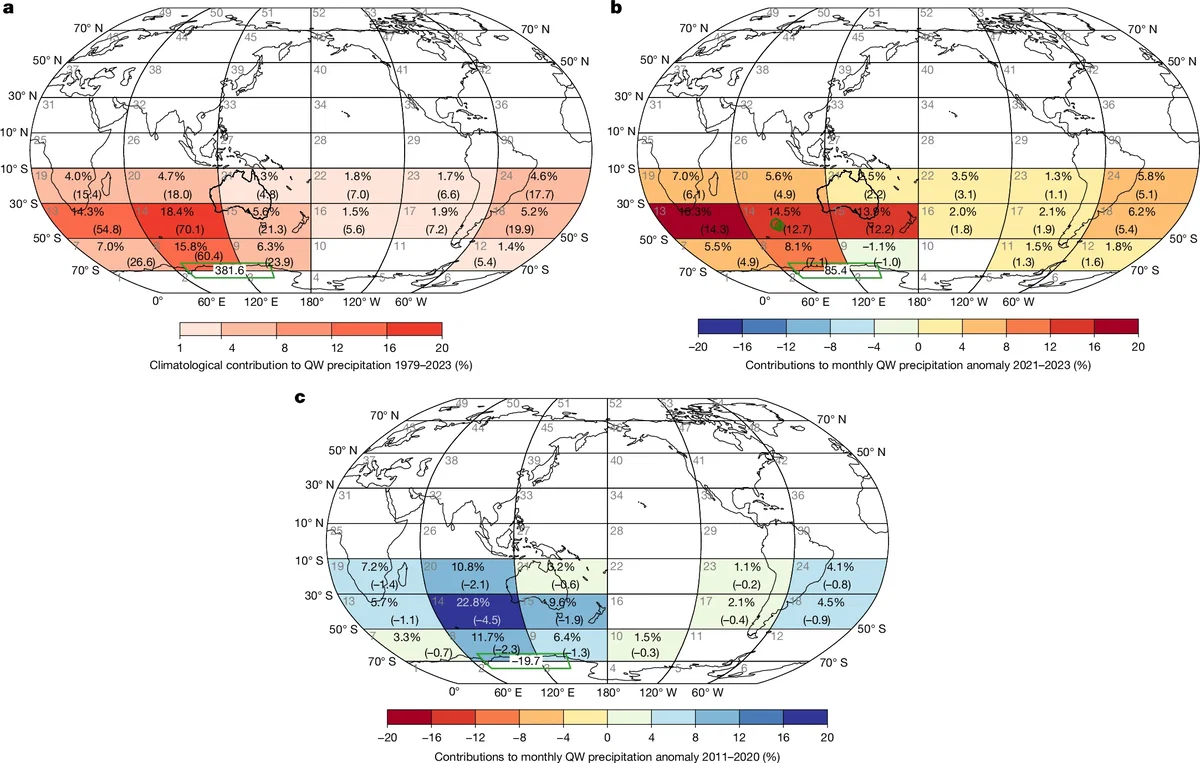
"This study demonstrates that the pronounced Antarctic mass gain during 2021–2023, dominated by accumulation in the QW region [Queen Maud Land] of EA, was favoured by a recurrent tropical–extratropical teleconnection driven by multiyear TWP SST [Tropical Warm Pool Sea Surface Temperature] warming with other tropical modes and anthropogenic [human-caused] forcing acting more as secondary modulators of the QW mass change than as the immediate drivers," concluded the report. "The results show that such events tend to occur about once per decade, and are consistently associated with a clear TWP–EA teleconnection across both observations and simulations."
The study noted that ice-core analysis at the Law Dome in Antarctica supported their conclusions about the seasonability, but not sustained impact of the teleconnection.
"When something changes, it is very tempting, even to scientists, to think 'oh, there's a new normal happening,' but this analysis shows that's not the case," Professor Steig explained before sharing, "This [sharp increase in precipitation in Eastern Antarctica] is most likely a short-lived phenomenon".
The image below shows exactly what researchers found.

As waters warmed in the red circle, they created a massive, yearslong weather pattern that resulted in increased precipitation over a specific portion of Antarctica.
Case closed right? Not so fast says the report, continuing to research how a myriad of climate changes impact teleconnections across the globe will be essential as our climate system and the resulting weather patterns shows increasing variance and cascading impacts.
"The mechanism that triggers and maintains prolonged TWP [Tropical Warm Pool] warming remains unclear," noted Wednesday's report. "Previous research on tropical–Antarctic teleconnections has focused largely on ENSO-related [El Niño/La Niña-related] pathways, especially the connections between central-eastern tropical Pacific SST [Sea Surface Temperatures] forcing and West Antarctica climate...However, the tropics can affect the climate of different Antarctic regions through many pathways. Here we identify the TWP–EA teleconnection, which acts as a recurrent climate driver, episodically producing precipitation extremes and associated mass gain or loss over QW and, at times, broader EA. Thus, the recent slowdown may represent a temporary halt in continued Antarctic mass loss that remains strongly affected by ocean-induced basal melt and dynamic ice loss."
"The duration of this temporary slowdown will probably depend on the combined effects of this teleconnection mode, ocean-induced basal melt and dynamic thinning around the continent in the coming decades, especially in West Antarctica and vulnerable EA outlet glacier sectors such as Totten Glacier," added the report. "How this teleconnection will change in the future remains uncertain, and its influence on Antarctic precipitation may be amplified in a warming world through changes in high-latitude moisture, AR intensity and storm tracks. Accurately representing this teleconnection in climate models is therefore essential for predicting Antarctic hydroclimate variability and improving sea-level projections."
